
|
Do-It-Yourself Propane In years past, we all had our propane delivered from local gas companies. As time has gone by, it's become more inconvenient and a lot more expensive. Perhaps it's just not worth their while to deliver into the hills anymore and they've got to jack up the prices. But it almost seemed that they were trying to keep making it more expensive (tank rental fees, delivery charges, etc.) until we stopped using them. A couple of years ago, Sue and I finally got sick of what they were charging and decided to look into handling the gas ourselves. Turns out that it's a LOT cheaper. Although there is some up-front equipment that you've got to buy, we figure that after two years, the savings will have paid for it. What are the costs? Yes, let's get to the bottom line. The primary costs are the tanks and the regulator. The most sensible way to do it is to have two tanks and an automatically switching regulator. Here's the rundown for that setup:
A non-switching regulator is considerably cheaper – about $20 or so. The difference is that when one tank runs out, the gas simply stops flowing and you've got to go out and switch it by hand. An automatically switching regulator switches to the second tank when the first one is drained, and the indicator on the top turns red. You'll also probably need an adapter to go from your existing gas line to the regulator (couple of bucks), and short hoses to go from the regulator to each tank (about $10 ea). The above prices of tanks and propane are from William's Coal & Oil in Marshfield. The regulator prices are from Drinkwater Trailer Sales in Pembroke. I was unable to find medium-sized tanks at Home Depot, but I suspect that if you can find a big-box home improvement center that supplies them, they'll be a LOT cheaper. Home Depot carries a 75lb tank for $60. Installation I put the tanks where the old ones had been. There was a stable platform there and the gas line was handy. To keep the inspector happy, I drove a pressure-treated 2x4 into the ground next to the tanks to act as a stablizer. I screwed an eyebolt into it and locked the tanks to it with chains. I screwed the switching regulator to the back of the 2x4. 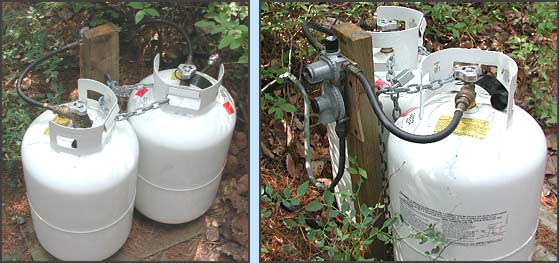 Other issues Note: When I told Amerigas that I didn't need their services anymore, they told me that there would be a $52 fee for them to come down and remove the tanks. When I balked at this, they told me that it's right there on the contract. I told them that if they could show me my signature at the bottom of this contract, I'd be happy to pay. The tanks are gone now, and I haven't paid the $52. But I heard that it was illegal to transport tanks larger than 20-lb in your car. Summary... Downside: You've got to fill the tanks yourself. Upside: Much cheaper in the long run. You get gas when you want it. No ugly 100-lb rusting tanks. Pat Traynor |